
Access Grady County Genealogy
Grady County genealogy records date to 1905, the year the county was formed from Decatur and Thomas counties. The Probate Court and Superior Court Clerk in Cairo maintain marriage licenses, wills, estate files, land deeds, and court records that help trace family lines in southwest Georgia. Grady County is one of Georgia's newer counties, so researchers looking for older family records will often need to check Decatur County and Thomas County as well. The courthouse in Cairo is the central point for genealogy research in this area, with records going back to the county's founding.
Grady County Quick Facts
Grady County Probate Court Records
The Grady County Probate Court is the primary source for marriage and estate records. Marriage licenses go back to 1905. The court also holds wills, letters of administration, guardianship records, and estate inventories. These are key for tracing families in Grady County.
Visit the courthouse in Cairo to search in person. Staff can help with lookups. For mail requests, send a written request with the name and approximate date of the record you need. Include a self-addressed stamped envelope and a check or money order for fees. Under O.C.G.A. § 15-9-30, the Probate Court has jurisdiction over wills, estates, guardianships, conservatorships, and marriage licenses in Grady County. Fees vary, so call ahead for current amounts.
| Address | Grady County Courthouse, 250 N. Broad Street, Cairo, GA 39828 |
|---|---|
| Phone | (229) 377-2912 |
| Hours | Monday - Friday, 8:00 AM - 5:00 PM |
Note: Grady County was formed from Decatur and Thomas counties in 1905, so check those parent counties for records before that date.
Grady County GAGenWeb Genealogy
The Grady County GAGenWeb page is a free volunteer-run genealogy site with cemetery transcriptions, census data, family trees, and records from other researchers.
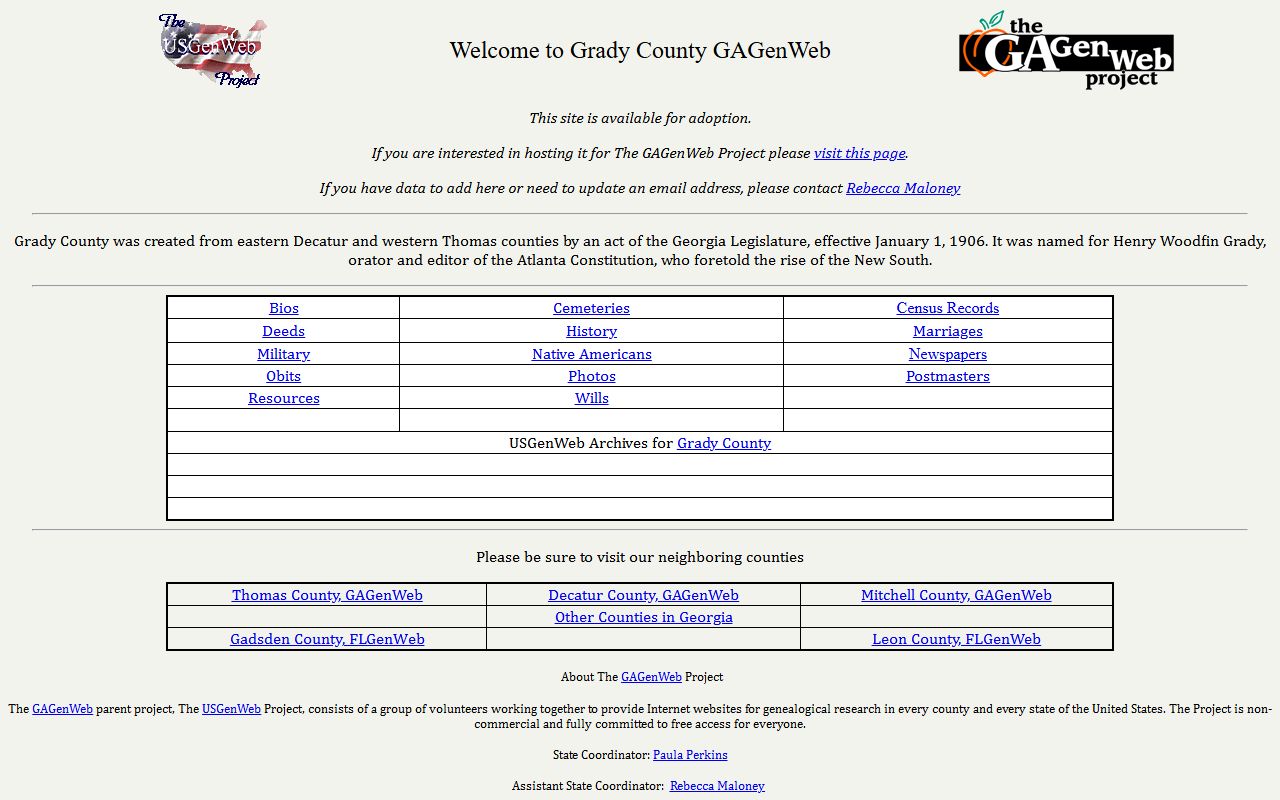
Volunteers post records they have found at courthouses, libraries, and archives. You can also find links to census transcriptions and local history that help put your Grady County ancestors in context. This is a solid first stop if you are new to genealogy research in the county.
Other free online resources include FamilySearch, which has Georgia marriages from 1754 to 1960, probate records from 1742 to 1990, and death records from 1914 to 1943. The Georgia Historic Newspapers archive has over one million pages of old newspapers with obituaries and legal notices that can help with Grady County genealogy.
Grady County Superior Court Genealogy
The Grady County Superior Court Clerk holds land records, divorce files, and civil and criminal case records from 1905 onward. Land deeds show property transfers, neighbors, and family connections. Deed books in Grady County document the agricultural families who settled in this part of southwest Georgia.
Divorce records are also maintained by the Superior Court. These files often name children, list property, and give ages or birth dates that confirm family ties. Under O.C.G.A. § 50-18-70, most court records are open to the public. You can get copies in person or by mail for a per-page fee.
Civil case files sometimes hold valuable genealogy data too. Property disputes, estate challenges, and guardianship cases can name multiple family members and give details not found elsewhere. When vital records are missing, court files can be a good backup source.
Note: For Grady County land records before 1905, check the Decatur County or Thomas County Superior Court Clerk offices.
Vital Records for Grady County Genealogy
Georgia started statewide vital records in 1919 under O.C.G.A. § 31-10-9. Since Grady County was formed in 1905, most early vital events were recorded under the newer statewide system. Birth and death certificates from 1919 forward are available from the Grady County Health Department or the Georgia Department of Public Health.
Birth certificates cost $25 for the first copy and $5 for each additional one. Death certificates are the same price. Under O.C.G.A. § 31-10-26, certified birth certificates are restricted to the person named, parents, grandparents, adult siblings, adult children, spouses, or legal guardians. Death certificates have fewer restrictions. The Georgia Virtual Vault has death certificates from 1919 to 1943 online at no cost.
Research Tips for Grady County
Start with what you know. Write down names, dates, and places. Then work backward. Census records are a natural next step. Federal census data from 1820 to 1940 is available at the Georgia Archives in Morrow through Ancestry.com. The 1790, 1800, 1810, and 1890 censuses for Georgia were destroyed, so use tax digests for those gaps.
Since Grady County was created in 1905, your ancestors may show up in Decatur County or Thomas County in earlier censuses. Pre-1900 records for the Grady County area are on microfilm at the Georgia Archives under those parent counties. The Archives is at 5800 Jonesboro Road, Morrow, GA 30260, open Tuesday through Saturday from 9:00 AM to 4:00 PM.
- Check cemetery records when vital records are missing
- Search church records for baptisms, marriages, and burials
- Look at Family Bible records on microfilm at the Georgia Archives
- Review estate records when birth or death dates are unknown
- Search Decatur and Thomas county records for pre-1905 data
County boundary changes are especially important for Grady County since it was formed so recently. The Virtual Vault has "Georgia Counties: Their Changing Boundaries" to help you trace which county your family was in at any given time. Under O.C.G.A. § 50-18-71, copy fees are capped at 10 cents per page for standard public records.
Note: The Georgia Archives has free access to Ancestry.com, FamilySearch, and Fold3 in the search room for genealogy researchers.
Cities in Grady County
Grady County includes the cities of Cairo and Whigham. All genealogy records are maintained at the Grady County Probate Court and Superior Court Clerk in Cairo. No cities in Grady County meet the population threshold for individual city pages.
Nearby Counties
These counties border Grady County. Many families in southwest Georgia crossed county lines, so checking neighboring records is important for thorough research.