
Baker County Genealogy Records
Baker County genealogy records date back to 1825, when the county was created from Early County in southwest Georgia. The Probate Court in Newton holds marriage licenses, wills, estate inventories, and guardianship files that span two centuries. The Clerk of Superior Court maintains land deeds, divorce records, and civil case files. Baker County is one of Georgia's smaller counties by population, but its courthouse records offer a rich source of genealogy data for families who settled in this part of the state during the early 1800s.
Baker County Quick Facts
Baker County Probate Court Genealogy
The Baker County Probate Court holds marriage and estate records going back to 1825. Marriage licenses, wills, letters of administration, guardianship files, and estate inventories are all housed here. These are the primary records for tracing Baker County family lines.
The courthouse is at 1 Main Street in Newton. You can visit in person or submit a request by mail. Include a self-addressed stamped envelope and payment by check or money order. Under O.C.G.A. § 15-9-30, the Probate Court has full jurisdiction over wills, estates, guardianships, conservatorships, and marriage licenses in Baker County. Certified copies typically cost $2.50 for the first page with $0.50 for each added page. Call ahead to check current fees before mailing your request.
Note: Before 1852, probate matters in Georgia fell under the Inferior Court, so older Baker County estate records may be filed under that name at the Georgia Archives.
| Address | 1 Main Street, Newton, GA 39870 |
|---|---|
| Phone | (229) 734-3004 |
Baker County Land and Court Records
The Baker County Clerk of Superior Court maintains land records, divorce files, and civil and criminal case records from 1825. Land deeds are one of the most useful genealogy sources in Baker County because they show property transfers between family members across generations. Divorce records list children, ages, and property. Civil case files sometimes reveal estate disputes and family relationships.
Under O.C.G.A. § 50-18-70, most court records in Georgia are public. The Open Records Act under O.C.G.A. § 50-18-71 caps copy fees at 10 cents per page for standard documents. Tax digests at the Superior Court help fill in census gaps. Georgia lost its 1790, 1800, 1810, and 1890 federal census data. For those periods, Baker County tax records can show where your ancestors lived and what property they held.
Vital Records for Baker County Genealogy
Georgia began statewide vital records in 1919 under O.C.G.A. § 31-10-9. For Baker County births and deaths before 1919, you need county-level sources. The Probate Court may hold some early records. Church records, cemetery transcriptions, and family Bibles are other good options for pre-1919 data.
Birth and death certificates from 1919 onward are available through the Georgia Department of Public Health or the Baker County Health Department. First copies cost $25, and extra copies cost $5 each. Under O.C.G.A. § 31-10-26, certified birth certificates are restricted to the person named, parents, grandparents, adult siblings, adult children, spouses, or legal guardians. Death certificates are more accessible for genealogy research.
The Georgia Virtual Vault offers free death certificates from 1919 to 1943. FamilySearch.org has indexed Georgia death records from 1914 to 1943 at no cost.
Note: Marriage records from 1952 to 1996 were also filed at the state level, so the Georgia Department of Public Health is another source for Baker County marriages from that period.
Baker County Online Genealogy Resources
Baker County does not have a county-specific image from the GAGenWeb project, but the Georgia Probate Courts Directory can help you find current contact information for the Baker County Probate Court.
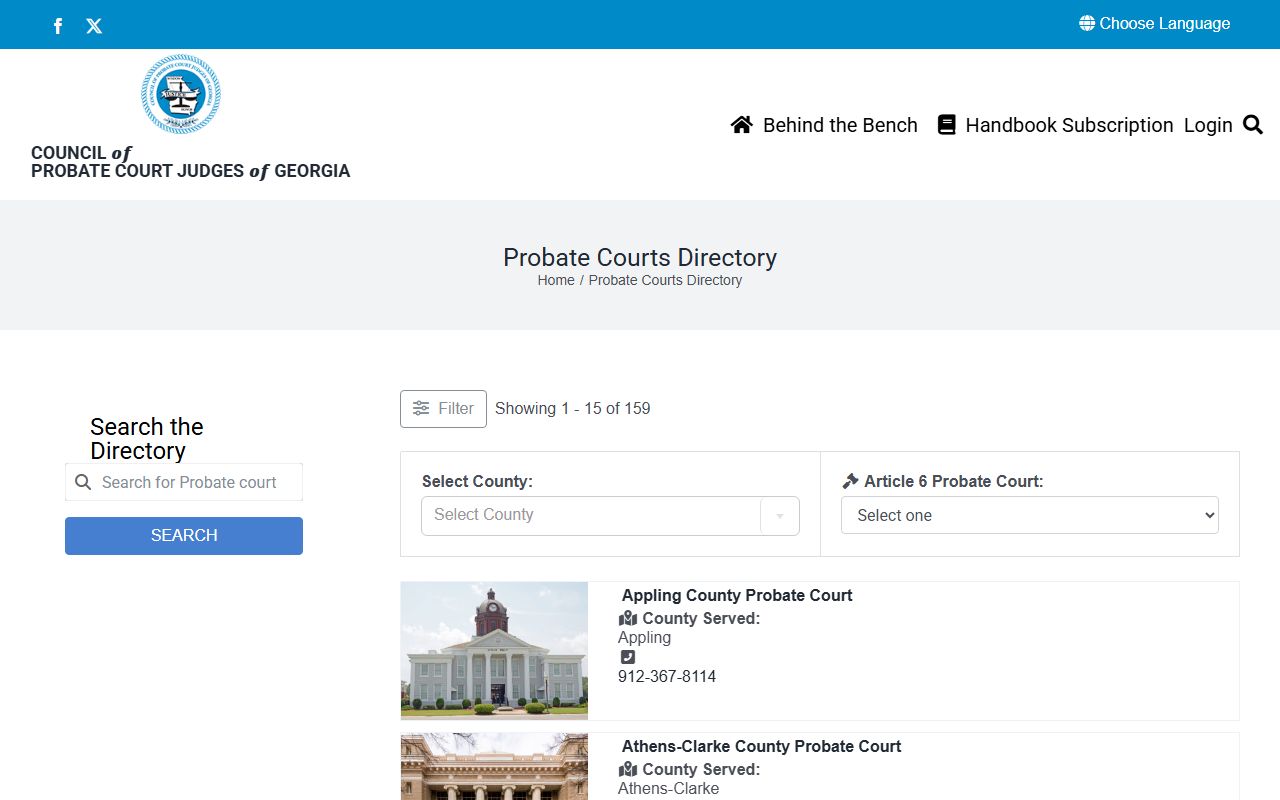
This statewide directory lists every probate court in Georgia, including Baker County, with phone numbers and addresses.
Free online resources include FamilySearch with Georgia marriages from 1754 to 1960, probate records from 1742 to 1990, and death records from 1914 to 1943. The Georgia Historic Newspapers archive has over one million pages of old newspapers with obituaries and legal notices that may help with Baker County genealogy.
Research Tips for Baker County
Start with what you know. List every name, date, and place connected to your Baker County family. Then work backward one generation at a time.
Census records are a strong next step for Baker County research. Federal census data from 1830 to 1940 is available at the Georgia Archives through Ancestry.com (free in the search room). The 1850 census was the first to list each person in the household by name and age. For years where census data is missing, use Baker County tax digests to find your ancestors. The Georgia Archives is at 5800 Jonesboro Road, Morrow, GA 30260. They are open Tuesday through Saturday, 9:00 AM to 4:00 PM.
- Check cemetery records and tombstone inscriptions when vital records are missing
- Search church records for baptisms, marriages, and burials
- Review estate records when birth or death dates are unknown
- Use the Vanishing Georgia collection for historical photos
Baker County was formed from Early County in 1825. Parts of the county were later carved off to form other counties. Georgia has 159 counties, and boundary changes happened often. The Virtual Vault has "Georgia Counties: Their Changing Boundaries" that tracks which county controlled what land at any point in history. This is important for Baker County because the lines shifted several times in the mid-1800s.
Cities in Baker County
Newton is the county seat of Baker County. All genealogy records for cities in this county are maintained at the Baker County Probate Court and Superior Court Clerk in Newton. No cities in Baker County meet the population threshold for a separate city page.
Nearby Counties
These counties border Baker County. If your ancestors moved within southwest Georgia, check neighboring county records. County lines in this region changed often during the 1800s.